
Scenario-Based Training Is Not Just Putting More Things Into One Flight
Changing the weather is not instructional design.
Most instructors have probably built some version of this flight.
It starts as a fairly ordinary navigation exercise. Somewhere along the way the weather begins to deteriorate. Perhaps the destination becomes marginal. Then the passenger starts feeling unwell. There is a problem with the radio. Fuel is becoming a little less comfortable than planned. Maybe the aerodrome closes, or another aircraft complicates the arrival.
By the end of it the student has been busy.
There has been plenty to talk about in the debrief. Decisions were made. Threats were managed. The exercise certainly felt more operational than flying a sequence of isolated manoeuvres.
It is easy to look at that and call it scenario-based training.
And sometimes it is.
But there is a useful question sitting underneath it:
What, exactly, did we want the pilot to get better at?
That question changes the way I think about scenario design.
Because if the answer is simply “dealing with a lot of things happening at once”, then piling complications into a flight probably achieves that. But if the real objective was recognising deteriorating margins, making an early decision about weather, managing workload, using available resources, or knowing when to stop trying to preserve the original plan, some of those extra complications may actually make the lesson less effective.
The scenario became more complicated.
That does not necessarily mean the learning became better.
The interesting part is not the event
When we first start thinking about scenario-based training, it is natural to think in events.
Weather deterioration. Passenger illness. Radio failure. Alternator failure. Unexpected runway change. Fuel issue. Diversion.
They are tangible. They are easy to put into a lesson plan. And they certainly create something for the pilot to respond to.
But the event is usually not the thing we actually care about.
Take deteriorating weather.
We do not really need a pilot to become highly skilled at responding to an instructor saying, “The weather has deteriorated. What are you going to do?”
We want them to notice that the situation is changing before somebody labels it for them.
Maybe the visibility at the destination is still technically acceptable, but it is worse than forecast. The cloud base has lowered at two reporting points. The route ahead becomes less forgiving. There is still plenty of fuel. The aerodrome behind has good weather. Another suitable option is slightly off track.
Nothing dramatic has happened.
There may not even be a clearly identifiable moment when the pilot must act.
And that is exactly what makes it useful.
The pilot has to interpret the information, recognise the trend, decide how much margin they are willing to consume and choose when the original plan stops being the best plan.
That is a much richer decision than responding to a declared weather emergency.
The same thing applies elsewhere. If the objective is workload management, we need a situation in which workload develops and has to be prioritised — not necessarily three unrelated failures. If the objective is threat and error management, we need meaningful threats and opportunities to recognise and manage them. If the objective is resource use, there needs to be useful information or support available that the pilot can choose to access.
Once we start thinking this way, the scenario becomes less about what happens to the aircraft and more about what is happening inside the pilot's decision-making process.
How much information do we give them?
There is another tension that appears once we start designing around decisions rather than events.
How much should the instructor tell the student?
Too little, and the scenario becomes artificial because the learner has no reasonable way of identifying the problem.
Too much, and we make the decision for them.
There is a big difference between saying “The weather is deteriorating” and giving the pilot the information from which a deterioration could reasonably be recognised.
The first gives them a conclusion.
The second gives them cues.
That distinction matters because operational flying is full of cues.
A fuel figure that is slightly different from expected. A maintenance comment that deserves another question. Weather that remains legal but is steadily becoming less comfortable. A passenger request that changes the time pressure. An unfamiliar runway combined with a strong crosswind. A small delay that removes some of the margin from the next sector.
Individually, none of those things necessarily tells the pilot what to do.
They create a picture.
And part of good decision-making is learning to recognise when that picture has changed enough that the plan should change with it.
That means there is an art to giving the student enough information to make a decision possible, without giving them the decision itself.
It also means we do not always need a dramatic trigger.
Sometimes the strongest scenario is the one where nothing actually fails.
What if there is more than one reasonable answer?
This is where scenario-based training can become uncomfortable for instructors.
We are used to standards. There are speeds that must be achieved, procedures that must be followed, limitations that must not be exceeded and actions that are clearly right or wrong.
But judgement does not always work that way.
Consider the weather example again.
One pilot may decide quite early that the trend is enough to justify turning around. Another might continue toward a suitable intermediate aerodrome and reassess from there. A third might alter the route to preserve better weather and more escape options.
Depending on the circumstances, all three decisions might be reasonable.
That creates a different instructional problem.
If I have already decided before the flight that the correct answer is to divert to Airport X, I can very easily keep adding pressure until the student eventually chooses Airport X.
They may even learn something from the exercise.
But they may also learn something I did not intend:
The purpose of a scenario is to work out what answer the instructor wants.
That is very different from developing judgement.
A better question is often whether the pilot's decision was safe, legal, timely, reasoned and defensible given the information available at the time.
That does not mean every decision is equally good. It does mean we need to distinguish between “different from the decision I would personally have made” and “poor decision-making”.
For instructors, that can be one of the hardest parts of scenario-based training. We have to know the standard very well while also being willing to allow a student enough space to exercise judgement within it.
Then comes the awkward question: when do we intervene?
If we give the learner genuine room to make decisions, eventually they will miss something.
That is part of the point.
So what do we do when they do?
There is a useful spectrum between immediately solving the problem for them and silently watching until the entire exercise collapses.
Sometimes another realistic cue is enough. Perhaps the weather report changes again. Perhaps ATC passes information that makes the trend clearer. Perhaps the passenger asks how much longer the flight will take.
Sometimes a question is appropriate: “What options do you have at the moment?”
Sometimes the workload has become so high that continuing no longer produces useful learning, and we need to pause, reduce it or talk through what has happened.
And sometimes safety requires an immediate intervention.
What matters is being conscious of which one we are doing.
This is particularly important because training and assessment are not the same activity.
During training, prompting can be completely appropriate. We are trying to develop competence.
During assessment, the same prompt may remove the very behaviour we were trying to observe.
If I have to repeatedly direct a pilot toward recognising deteriorating weather during an assessment of decision-making, that tells me something quite different from doing exactly the same thing during their first exposure to the concept.
Scenario design is not only about designing what happens. It is also about deciding how the instructor will respond to what happens.
The debrief is where much of the learning appears
One of the things I like most about a well-designed scenario is that the most interesting part of it is often not obvious until afterwards.
Two pilots can experience exactly the same flight and be thinking about completely different things.
The first may have recognised the changing weather twenty minutes earlier but decided the margin remained acceptable. The second may not have noticed the trend until much later.
Their eventual actions could look almost identical.
If we only debrief the outcome, we miss that.
Instead of asking simply “Why did you divert?”, there is more value in reconstructing the decision.
What was the first thing you noticed? At that point, what did you think your options were? What information were you waiting for? What changed the balance for you? Was there a point where you had already decided what you were going to do but had not acted yet? What would have made you make that decision five minutes earlier? What would have made you continue?
Now we are not just discussing what happened.
We are looking at how the pilot recognised, interpreted and responded to the situation.
There is also an important distinction between outcome and reasoning.
A poor decision can have a perfectly acceptable outcome. A very sound decision can still result in inconvenience, a diversion, a stranded aircraft or an unhappy passenger.
Operational training becomes dangerous if we accidentally teach “It worked, therefore it was a good decision.”
Given what you knew at the time, was that a defensible decision?
That is something a pilot can carry into a completely different situation later. And that transfer is ultimately what we want.
Good scenario design does not require expensive infrastructure
None of this requires an elaborate simulator program.
Simulation can be extraordinarily valuable where it provides safe access to situations we cannot or should not reproduce in an aircraft. But good instructional design is not measured by how much equipment, time or complexity we can put around the exercise.
In a small GA operation, the scenario may be nothing more complicated than changing one piece of information during an otherwise normal flight and giving the pilot enough room to recognise what that change means.
The destination weather trends down. A runway becomes unavailable. A passenger request changes the time pressure. The pilot is given an unexpected but entirely plausible piece of operational information.
One deliberate decision can be more useful than five manufactured emergencies.
The mechanism can be simple. The thinking behind it should not be.
So what actually makes a scenario?
The more I have thought about this, the less useful I find the idea that scenario-based training means making a flight more complicated.
Instead, I find myself coming back to a handful of questions.
What competence are we actually trying to develop? What real-world context would require that competence? What information would the pilot genuinely have available? Where are the meaningful decision points? What happens if they choose differently? How will we help them examine their reasoning afterwards?
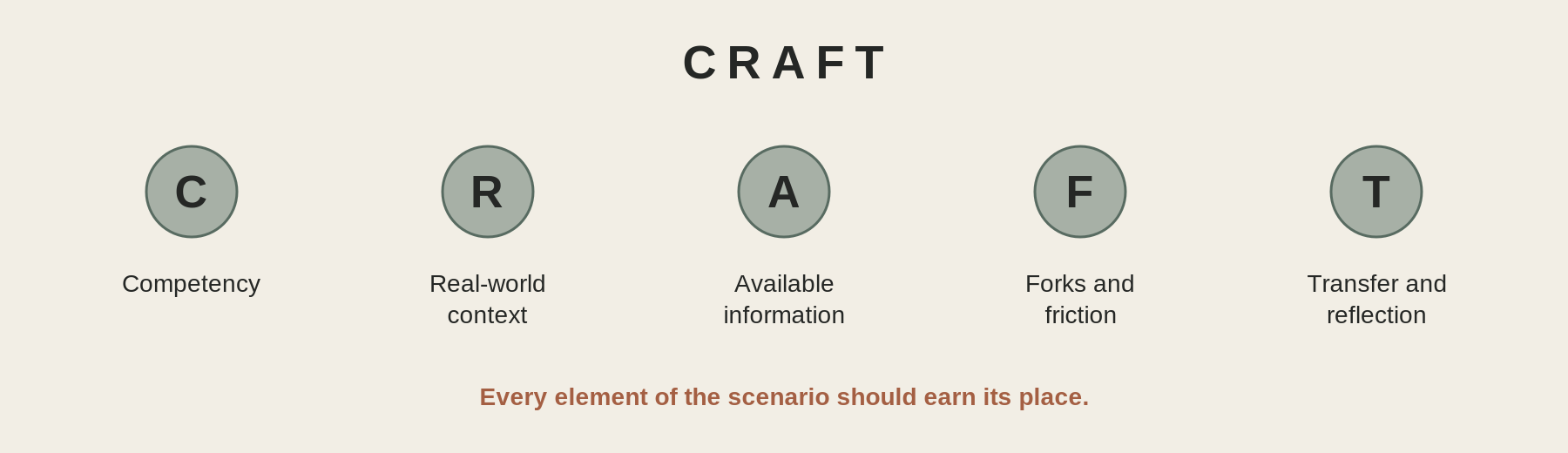
Those questions eventually became a simple framework I use when thinking through scenarios:
Competency — what do we want the learner to become better at?
Real-world context — why does this decision naturally arise here?
Available information — what cues does the pilot actually receive?
Forks and friction — where are the genuine choices, competing priorities and consequences?
Transfer and reflection — how will we help the learner recognise and use this thinking somewhere else?
It happens to spell CRAFT, which fits rather neatly.
But the acronym is not really the important part.
The important part is that it forces us to work backwards from the learning rather than forwards from an interesting collection of events.
The quieter scenario may be the better one
And sometimes, after doing that, the scenario gets simpler.
The passenger no longer needs to become sick. The radio does not need to fail. We do not need to manufacture a fuel problem or keep adding pressure simply because the student is coping with what is already there.
The changing weather and the decisions around it may be enough.
That can feel almost counterintuitive. A quieter scenario can look less sophisticated from the instructor's seat. There may be fewer things to manage and fewer events to discuss afterwards.
But it can create much more room for the learner to notice what is changing, decide what matters, consider the available options, commit to a course of action and then examine why they made that choice.
That is the part worth designing for.
The measure of a good scenario is not how much went wrong during the flight. It is whether the scenario created the right conditions for useful thinking — and whether that thinking can be recognised and carried into the next situation when the instructor is no longer sitting beside them.
So the question I want to start with is no longer “What can I make happen on this flight?”
It is:
What do I want this pilot to become better at recognising, thinking through and deciding for themselves?
Once that is clear, the weather, the passenger, the diversion, the failure — or the decision to use none of them — become instructional tools rather than the point of the exercise.
Scenario-based training is not about making the flight more complicated. It is about making the thinking more deliberate.
References & further reading
CASA — AC 61-08: Teaching and assessing non-technical skills for single-pilot operations
